Showing posts with label Heart of Darkness. Show all posts

Wednesday, August 27, 2008

Angel

"this pure brow, seemed surrounded by an ashy halo from which the dark eyes looked out at me. Their glance was guileless, profound, confident, and trustful." (69)

Kurtz's lover is producing light which shows that she is a symbol for an angel. She is clean and innocent like an angel, because she has never traveled like the men do in this novel, to tarnish her thoughts and belief in humanity. Marlow has been tarnished by his travels so he produces darkness instead of light, so when she looks at him this darkness is reflected in her eyes. She is confident that Kurtz died the same man as he was before he went into Africa. She is wrong about this, but Marlow lies to her to keep her pure.

Shadow

"a shadow darker than the shadow of night." (68)


Shadows are a common thread in this novel. They symbolize imperialism and its deceit. Marlow casts a shadow around him when he goes to Kurtz's lover's house. This shadow represents his knowledge of Kurtz, that would hurt the women. He knows that Kurtz wanted justice and to stay in Africa more than he wanted to go home to her.

Drum

"the beat of the drum, regular and muffled like the beating of a heart- the heart of a conquering darkness." (68)

Marlow now has the steady beat of the drum in his heart. This pulse symbolizes the change he has when he heard the drums at Kurtz's. He is forever enlightened and will always have the beat of a drum in his heart.

Tuesday, August 26, 2008

God

"Some of the pilgrims behind the stretcher carried his arms- two shotguns, a heavy rifle, and a light revolver carbine- the thunderbolts of that pitiful Jupiter. " (55)

Jupiter was a powerful god of the sky from Greek mythology, who had power over men and other gods. Jupiter used lightening as a weapon. Kurtz is a symbol for a god, because he has guns and is civilized. The guns seem like magic to the savages, so he seems mighty to them.

Fleet Street

"I went on along Fleet Street" (6)

Fleet Street is one of the main streets in England. It is named after the Fleet River, which is one of the rivers that now flows beneath London's streets to the Thames. The first newspaper, called The Daily Courant, was issued from this street in 1702. It was the center of London's publishing industry, so it has been mentioned in many literary figures.


~"Fleet Street" Streets of London. August 26, 2008. <http://www.touruk.co.uk/london_streets/fleet_street1.htm>

Snake

"a mighty big river, that you could see on the map, resembling an immense snake uncoiled, with its head in the sea and, its body at rest curving afar over a vast country, and its tail lost in the depths of the land." (6)

The Congo River is being compared to a snake because snakes can be poisonous. Marlow is fascinated with the snake like a bird would be. It also symbolizes the snake in the Genesis, that convinces Eve to eat the forbidden fruit that causes original sin. The snake lures Marlow to go up the Congo, which is poisoned with deceiving imperialism.

Knights


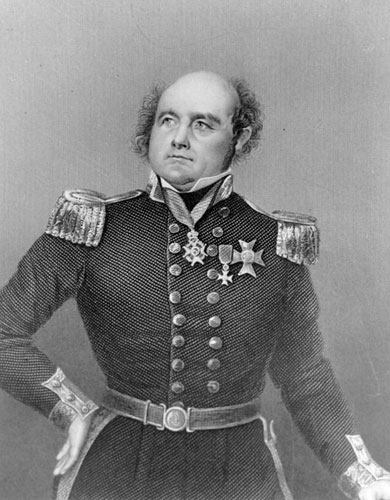
"It had known and served all the men of whom the nation is proud, from Sir Francis Drake to Sir John Franklin." (2)


Sir Francis Drake (left) set out from England in 1577 on a great adventure known as the Golden Hind. They traveled south to Africa and South America. They traveled for nearly three years and went approximately 36,000 miles. Sir John Franklin (right) set out from England in 1756 and disappeared. His expedition was in northern Canada. The two left from the Thames river and went in different directions at different times. Joseph Conrad mentions these men because many great adventures have started at the mouth of the Thames and it foreshadows that Marlow's adventure is profound.

~Secoy, Diane. "Franklin, Sir John" The Encyclopedia of Saskatchewan. 2008. August 26 2008. <http://esask.uregina.ca/entry/franklin_sir_john_1786-1847.html>
~Seeler, Oliver."The Voyage" Sir Francis Drake. 2001. August 26, 2008. <http://www.mcn.org/2/oseeler/voy.htm>

Morituri te Sautant

"Ave! Old knitter of black wool. Morituri te sautant. Not many of those she looked at saw her again-not half, by a long way." (8)

Morituri te salutant is a Latin term for "those who are about to die salute you". Ave means hail in Latin. It was a gladiator's salute. Marlow is hailing the knitting women because she symbolizes the emperor that he may die for. Marlow is venturing up the Congo for the Belgian Colonial Company and will either come out effected greatly or not come out at all.


~New York Times Company. "Morituri te salutant = Those who are about to die salute you" About.com. 2008. August 26 2008<http://ancienthistory.about.com/od/games/qt/morituritesalut.htm>

Buddah


"Marlow ceased, and sat apart, indistinct and silent, in the pose of a meditating Buddha." (72)


Buddha Shakyamuni was born in 624 BC as a royal prince in India. He left his palace and meditated for years until he reached enlightenment. He is the founder of the Buddhist religion. Buddha can mean the historical Buddha Shakyamuni or refer to anyone who has attained full enlightenment. Marlow is being related to a meditating Buddha because his trip down the Congo enlightened him. He is no longer ignorant and sees things as they truly are.


~Gyatso, Geshe. "Who is Buddha" About Buddha. 2007. August 26, 2008. <http://www.aboutbuddha.org/english/index.htm/>

Gravesend

"The air was dark above Gravesend, and farther back still seemed condensed into a mournful gloom, brooding motionless over the biggest, and the greatest, town on earth. " (1)

Gravesend is an important town on the south side of the Thames in Kent, England. It is so important because it is at the mouth of the river and a main port that trades with London. As the men leave Gravesend, it is described as dark and gloomy. The darkness of the cities behind the men are a symbol for civilization. Darkness also symbolizes Africa and its dark unsettled areas. Before the Romans conquered England, the people there were dark and uncivilized.

~"History of Gravesend, Kent"Kent Business Directory. August 26, 2008<http://www.kentfind.co.uk/about/gravesend/history.php>

Martini-Henry

"It contained a couch, two camp stools, a loaded Martini-Henry leaning in one corner, a tiny table and the steering wheel." (40)


A Martini-Henry was the first rifle that was designed as a breech loading metallic cartridge rifle. The weapon had a falling block, self-cocking, lever operated, single-shot action that was designed by Friedrich von Martini. Alexander Henry designed the barrel.


~ Jason, Atkin. "Overview" Martini-Henry Rifles and Carbons. August 20, 2007. August 26, 2008. <http://www.martinihenry.com/>

By Jove!

"by Jove" (40)

Jove was an older Roman name for Jupiter. He was the Roman god of the sky and had power over men and gods. If he was angry at a person he would throw bolt of lightening at them. The expression emphasizes a phrase and is a nicer way of saying by God.

~ Quinion, Michael Quinion. "By Jove" Worls Wide Words. 2008. August 26, 2008<http://www.worldwidewords.org/qa/qa-byj1.htm>

White Lead

"I had no time! I had to mess about with white lead and strips of woolen blanket helping to put bandages on those leaky steam pipes" (33)

White lead is a white powder that is used as a a putty when oil is added to it. It is heavy and a basic lead carbonate, 2PbCO3·Pb(OH)2.

~The American Heritage Dictionary of the English Language, Fourth EditionCopyright © 2006 by Houghton Mifflin Company.

Monday, August 25, 2008

Winchester Rifle

"darting scared glances, with Winchesters at 'ready' in their hands." (36)

Winchester rifles are one of the earliest repeating rifles, which means the single barrel rifle can have multiple rounds of ammunition. The pilgrims on Marlow's steam boat used these rifles against the natives Stone Age arrows. The natives were baffled by guns and this was one of the reasons the Europeans were able to manipulate and control the natives.

~"Volacanic Rifle" Nation Master. 2005. August 26 2008. <http://www.nationmaster.com/encyclopedia/Volcanic-Rifle>

Cipher

"They were in cipher! Yes, it looked like cipher. Fancy a man lugging with him a book of that description into this nowhere and studying it-and making notes-in cipher at that!" (34)

Cipher is the same thing as a code, but the concepts are distinct in cryptography. Marlow is surprised to find a code written in the book he finds. This find makes him eager to find out about the intelligence that lays ahead.

~"cipher." Dictionary.com Unabridged (v 1.1). Random House, Inc. 27 Aug. 2008. <Dictionary.comhttp://dictionary.reference.com/browse/cipher>.

Prehistoric

"We were wanderers on prehistoric earth, on an earth that wore the aspect of an unknown planet. We could have fancied ourselves the first of men" (32)

As Marlow's steamboat travels farther up the Congo they seem to be going back in time. It is so quiet at times that the men feel as if they are the only men on the planet, but then they will hear drums or see Africans dance like prehistoric mad men. Time is surreal because their surroundings are prehistoric, but they are advanced and civilized.

Huntley and Palmer Biscuit Tin


"She rang under my feet like an empty Huntler and Palmer biscuit tin kicked along a gutter, she was nothing so solid in make, and rather less pretty in shape, but I had expended enough hard work on her to make me love her." (25)

Huntley and Palmer was a British company that made biscuits and packaged them in decorative tins. It was one of the first global brands in the World. Marlow relates his stem boat to Huntler and Palmer biscuit tin, because both are not very durable. Marlow is saying that his steamboat is not perfect, but he was proud of what he had.

Savage Dog

"He was there below me, and, upon my word to look at him was as edifying as seeing a dog in a parody of breeches and a feather hat, walking on his hind legs." (33)

In this similie Marlow shows how inhuman the savages are thought to be. A savage is taught to be the fireman for Marlow's steamboat and is now obediant like a dog. Marlow is disturbed by a grove where the labors went to die, but then thinks of his fireman as inhuman. Marlow seems like he realizes that the natives are treated like animals, but does not nessisarily disagree with it.

Pilgrims with Staves

"The pilgrims could be seen in knots gesticulating, discussing. Several had their staves in their hands. I truly believed they took these sticks to bed with them." (22)

Staves is plural for staff, which is a pole. In this case the staves were used to beat the native laborers. A pilgrim is one who embarks on a quest for something thought to be sacred. Marlow calls them pilgrims because they are blinded by the wealth of the ivory as if it were their religion.

Papier-mâché Mephistopheles

"I let him run on. This papier-mâché Mephistopheles, and it seems to me that if I tried I could poke my forefinger through him, and would find nothing inside but a little loose dirt, maybe." (23)

Mephistopheles is a name given to a representation of the devil. Papier-mâché is pieces of paper stuck together by a paste to make a hollow structure. Marlow is using papier-mache as a metaphor for the brick maker and the other men he meets at the Central Station. These people have no interior, but evil thoughts of imperialism.

~"Mephistopheles" Faust. 2008. August 26, 2008. <http://www.faust.com/index.php/legend/mephistopheles/>